Tank or Tankless Water Heater? Compare Options and Repair Signs
Tank water heaters offer stored hot water and simpler replacement, while tankless models save space and heat water on demand. PlumbingKentwa.info compares the trade-offs and explains when repair or replacement makes sense.
Request an EstimateTank and Tankless Water Heaters: What’s the Difference?
A storage tank water heater stores heated water in an insulated tank, while a tankless water heater heats water as it flows through the unit.
Stored hot water can serve several fixtures when the tank has enough capacity. On-demand water heating uses a burner or heating element when hot water flows, so the unit doesn't keep a full tank warm.
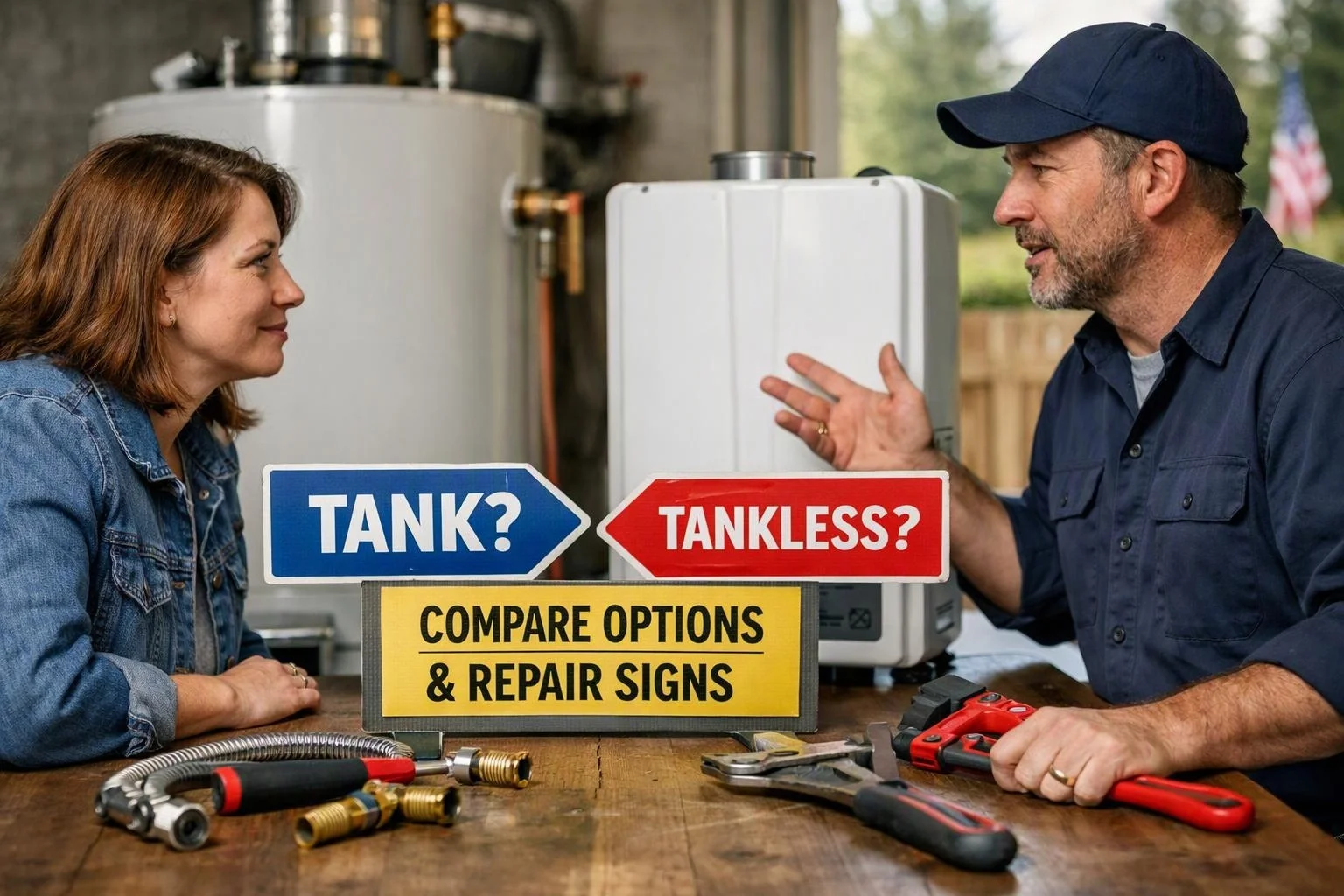
Each water heating method has a different operating pattern. The right choice depends on hot water demand, available space, fuel type, and installation conditions.
How Do Tank and Tankless Water Heaters Compare?
Tank water heaters suit buyers who value stored capacity and simpler installation, while tankless water heaters suit buyers who want on-demand heating and a smaller footprint.
Energy use changes with the operating pattern and household demand. A tank can lose heat while stored water waits, while a tankless unit mainly uses energy during hot water use.
| Factor | Tank water heater | Tankless water heater |
|---|---|---|
| Energy use | May use energy to maintain stored water temperature. | Heats water as needed, which can reduce standby heat loss. |
| Hot water capacity | Provides stored capacity until the tank recovers. | Provides continuous delivery when demand stays within its flow rate. |
| Space requirements | Needs floor space and clearance around the storage tank. | Uses less physical space but still needs service access. |
| Installation complexity | Often uses existing water, fuel, venting, or electrical connections. | May need updated venting, gas supply, electrical service, or water connections. |
| Maintenance | May need sediment removal, anode rod checks, and valve testing. | May need mineral deposit removal and heat exchanger service. |
| Operating pattern | Heats and stores water before use. | Heats water during use. |
| Equipment lifespan | Depends on tank condition, corrosion, water quality, and maintenance. | Depends on heat exchanger condition, water quality, use, and maintenance. |
Tank models can offer familiar controls and a straightforward replacement path. Tankless models can fit tighter spaces, but water heater sizing and installation requirements need careful review.
Which Water Heater Is Better for Your Home?
The better water heater depends on household demand, available space, fuel service, installation conditions, and long-term priorities.
Households with steady, moderate use may value the compact design of a tankless unit. Homes with high simultaneous demand may need careful flow-rate planning or a storage system with suitable capacity.
Fuel type also matters. A gas tankless water heater may need suitable venting and gas line capacity, while an electric tankless water heater may need adequate electrical service and circuit capacity.
Budget priorities include the equipment, water heater installation, future maintenance, and expected energy use. We review these factors before recommending a replacement option.
What Are the Signs a Water Heater Needs Repair?
A water heater needs prompt repair when it leaks, loses reliable hot water, makes unusual sounds, or shows a fault.
Some signs point to a small part, while others can signal internal damage. We inspect the source before recommending water heater repair or replacement.
Turn off the fuel or electrical supply only if you can do so safely, and keep clear of hot water. Contact our team when the unit leaks, smells of gas, shows electrical damage, or has a relief-valve problem.
Should You Repair or Replace Your Water Heater?
Repair makes sense when the fault is limited and the unit remains sound, while replacement makes more sense when damage is widespread or failures keep returning.
Our repair assessment considers the leak source, controls, connections, and overall unit condition. A tank with serious tank corrosion usually needs a replacement assessment because internal damage can spread.
Tankless equipment needs a close look at the heat exchanger, sensors, controls, and water passages. Mineral deposits can reduce performance, but cleaning or part replacement may restore a sound unit.
Recurring breakdowns can reduce the value of another repair. We explain the repair value, replacement options, and expected installation conditions so you can make a clear decision.
For a focused review, our Water Heater Repair service connects repair assessment with replacement planning when needed.
What Changes the Cost of Water Heater Replacement?
Water heater replacement cost depends on the unit type, site conditions, fuel connections, venting, electrical work, code needs, and removal.
A direct replacement may use existing water connections and fuel service. A change from tank to tankless can add work involving venting, a gas line, electrical service, or circuit capacity.
Other cost drivers include the drain pan, shutoff valve, water quality needs, code compliance, inspection requirements, site access, and disposal of the old unit.
Our quote explains the selected equipment, connection work, vent pipe changes, safety parts, removal, and installation conditions. Contact us for an exact quote based on your home and chosen water heater.
How We Check a Water Heater Before Repair or Installation
Our water heater inspection checks the appliance, its connections, safety controls, and the conditions around the installation.
We use the findings to prepare a repair assessment or replacement assessment. Our team also explains the quote scope before work begins.
Water Heater Installation must follow the appliance requirements and local code rules. We handle regulated gas, plumbing, and electrical work through a safe professional process.
Common Questions About Tank and Tankless Water Heaters
Tankless water heater maintenance and tank water heater maintenance address different parts and failure risks.
Good water heater sizing starts with household demand, fixture use, flow rate, recovery rate, fuel type, and water quality. Professional installation helps match those needs to the available connections and space.
Questions About Choosing a Tank or Tankless Water Heater
Do tankless water heaters run out of hot water?
Tankless water heaters can keep supplying hot water when demand stays within the unit's flow rate and capacity. Multiple fixtures can exceed that flow rate, so correct sizing matters.
Do tankless water heaters need different installation connections?
Yes, tankless water heaters can need different gas, venting, electrical, and water connections. Our team checks the existing installation before selecting equipment.
Can hard water affect a tankless water heater?
Yes, hard water can leave mineral deposits inside a tankless water heater's heat exchanger. Maintenance needs depend on water quality, use, and the manufacturer's requirements.
What should you do when a water heater starts leaking?
When a water heater starts leaking, protect people from hot water and contact our team for an inspection. A leak from the tank, relief valve, or connection needs a different repair decision.
Can a water heater be repaired if it makes popping or rumbling sounds?
Yes, a water heater can sometimes be repaired when popping or rumbling comes from sediment buildup and the unit remains sound. Our team checks the tank, heating parts, controls, and safety components before choosing repair or replacement.
Contact our team to discuss the water heater problem, installation conditions, or replacement options.
Get a Free Estimate